Open mobile app

AlexMon–Fri: 11:00 AM — 8:00 PM
Need a hand? We’re just a call away and happy to help out.
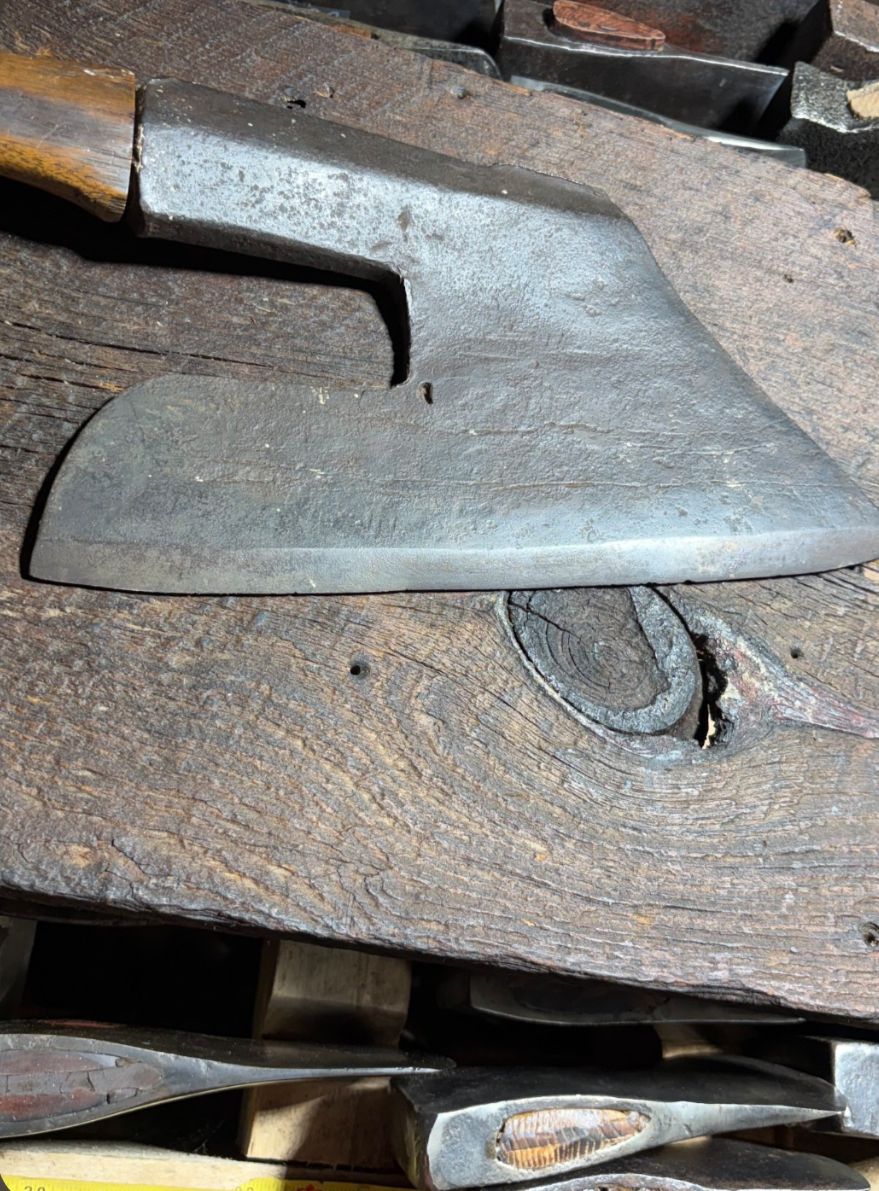
The J. Weber Goosewing Hewing Axe is a distinctive early American timber-framing tool characterized by its massive, asymmetrical, wing-shaped blade resembling a goose in flight. Hand-forged from iron with a high-carbon steel cutting bit welded onto the edge, it features a single-bevel edge flat on one side to slice cleanly along logs. The axe incorporates a canted, offset eye socket designed to keep the handle angled away from the timber, protecting the hewer’s knuckles during work. Stamped with the maker’s mark "J. WEBER", this axe stands as a premier example of 18th to 19th-century Pennsylvania-German blacksmithing.
History
The goosewing design originated in Central Europe (primarily Germany and Switzerland) and was brought to North America by German settlers establishing communities in Pennsylvania during the 18th century. Pennsylvania blacksmiths refined the European form by adjusting the center of gravity closer to the user’s hands and perfecting the canted socket.
Working in regional Pennsylvania, blacksmith J. Weber forged custom edge tools for local timber framers, barn builders, and carpenters. Hewing axes like this were essential for converting round logs into square architectural beams before mechanical sawmills became widespread. Because the offset socket and single bevel required dedicated orientation, these axes were forged explicitly as right-handed or left-handed tools. By the mid-1830s to 1840s, goosewing axes were largely replaced by more symmetrical, standardized American broad axes, making original signed pieces by makers like J. Weber rare historic collectibles.
Dimensions
Blade Edge Length: ~11 to 14 inches
Head Width (Poll to Edge): ~7 to 9 inches
Overall Length (with handle): ~18 to 28 inches
Total Weight: ~4 to 6 lbs
Need a hand? We’re just a call away and happy to help out.