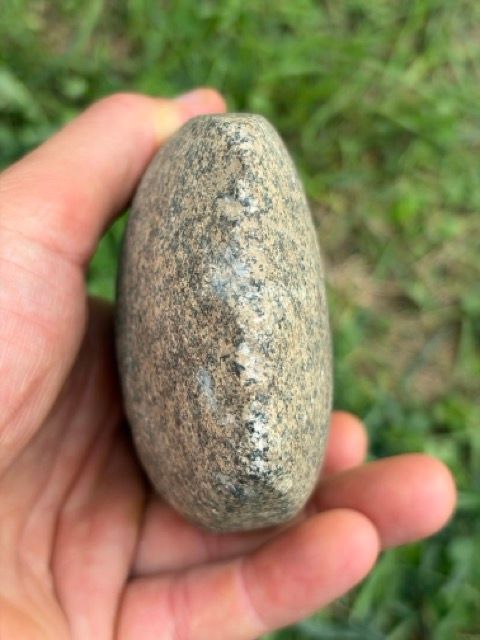
Ancient Native American Prehistoric Granite Full-Grooved Axe Head | Clark County, Indiana
$175.00
In stock: 1 available
Product Details
An authentic Archaic Period Native American artifact, this full-grooved stone axe head was ground and pecked from dense, speckled granite in Clark County, Indiana. Designed for heavy hafting, it features a complete, deeply carved channel encircling the poll, allowing sinew or rawhide to firmly bind the stone to a split wooden handle. The polished bit displays light, authentic ancient use-wear, while the surface retains the characteristic pecked texture and smoothed patina typical of high-grade prehistoric lithic craftsmanship from the Ohio River Valley region.
Detailed History & Cultural Significance
-
Archaic Period Provenance: Full-grooved axe heads are defining artifacts of the Middle to Late Archaic Period (c. 6,000 to 3,000 BCE). Predating the widespread use of ceramics and agriculture in the Ohio River Valley, these heavy ground-stone tools were vital for land clearing, heavy woodworking, house construction, and splitting logs.
-
Geographical Context (Clark County, IN): Situated along the Ohio River, Clark County was a major hub of prehistoric activity, trading networks, and resource gathering. Granite cobbles transported south during glacial movements provided indigenous artisans with dense, durable metamorphic stone superior for heavy-impact tools.
-
Peck-and-Grind Manufacturing Method: Creating a granite axe required dozens of hours of labor. Craftsmen used a harder hammerstone to repeatedly peck away minute chips, shaping the rough outline and channel. The bit was then painstakingly ground smooth and polished using sandstone abraders, water, and grit to create a resilient cutting edge.
Dimensions & Weight
-
Overall Length: 5.75 inches
-
Width (At Groove): 3.25 inches
-
Thickness (Poll Depth): 2.12 inches
-
Bit Cutting Edge Width: 2.85 inches
-
Total Weight: ~2.4 lbs (38.4 oz)
Ancient Native American Prehistoric Granite Full-Grooved Axe Head | Clark County, Indiana