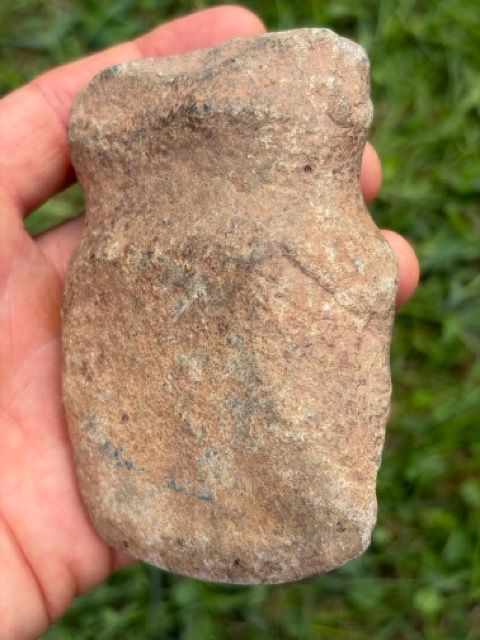
Ancient Native American Small Full-Grooved Stone Axe / Hatchet Head | Prehistoric Artifact
$105.00
In stock: 1 available
Product Details
An authentic, small-scale prehistoric Native American full-grooved stone axe (often classified as a belt axe or hatchet), hand-pecked and ground from dense, dark river cobble. Designed for high mobility, this compact lithic tool features a continuous, fully encircling hafting groove designed to be bound to a split wooden handle using wet sinew or rawhide. Despite its small stature, the piece exhibits exceptional craftsmanship, with a well-formed poll, balanced proportions, and a tapered bit showing light ancient polish and authentic use-wear along the cutting edge.
Detailed History & Cultural Significance
-
Archaic Period Craftsmanship: Full-grooved stone axes date primarily from the Middle to Late Archaic Period (c. 6,000 to 3,000 BCE). Small-pattern grooved axes were specialized tools engineered for lighter woodworking, shaping wooden utensils, dressing game, processing hide, or serving as personal sidearms/belt tools.
-
Peck-and-Grind Lithic Technology: Prehistoric artisans selected hard, non-chert metamorphic or igneous river stones (such as greenstone, basalt, or granite) that wouldn't shatter under repeated impact. The maker used a hammerstone to painstakingly peck thousands of tiny indentations into the rock to shape the groove and body before using wet sandstone sand to grind and polish the bit to a smooth cutting edge.
-
Hafting Mechanics: The full groove offered 360-degree contact for flexible wooden hafts or wrapped saplings. As the rawhide wrappings dried, they contracted tightly around the stone groove, creating an exceptionally strong shock-absorbing connection between the handle and head.
Dimensions & Weight
-
Overall Length: 3.85 inches
-
Width (At Groove): 2.25 inches
-
Thickness (Poll Depth): 1.45 inches
-
Bit Cutting Edge Width: 1.75 inches
-
Total Weight: ~11.8 oz (0.74 lbs)
Ancient Native American Small Full-Grooved Stone Axe / Hatchet Head | Prehistoric Artifact