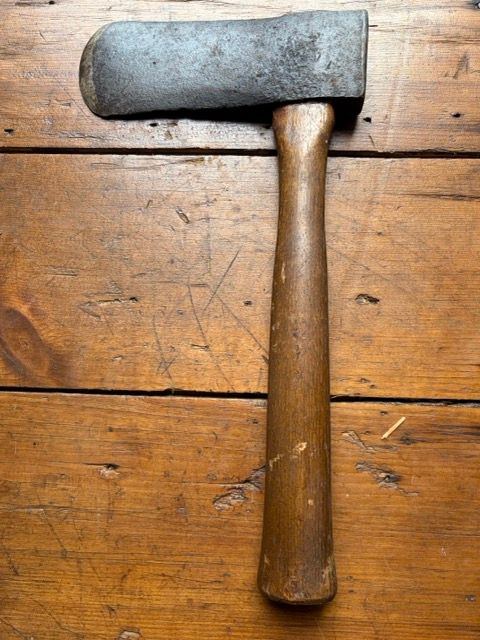
Antique Turpentine Hack Axe / Boxing Hatchet – Forged Iron Naval Stores Tool (Cracked Head)
$75.00
In stock: 1 available
Product Details
This rare antique turpentine axe (also known as a boxing hatchet or turpentine hack) is a classic example of 19th to early 20th-century Southern American forestry and industrial trade tools. Designed with a long, narrow profile specifically for cutting "boxes" into longleaf pine trees to collect pine resin, this piece is an authentic relic of the historic naval stores industry.
-
Blade & Head: Forged iron/steel construction with a distinct elongated bit and narrow poll. Features an authentic dark age patina, historic surface oxidation, and character marks. Note on Condition: There is a visible crack in the head (near the eye/blade body), making this item best suited as a historical display piece, collector's specimen, or repair project rather than a working tool.
-
Handle / Eye: Features a traditional eye configuration. (Note whether it includes a vintage wood handle or is sold head-only).
-
Condition: Fair/as-found antique condition. Displays honest age, heavy patina, and a structural crack in the metal as noted.
History
In the 18th, 19th, and early 20th centuries, the "naval stores" industry—producing turpentine, rosin, pitch, and tar—was a massive economic engine across the pine forests of the American South (particularly North Carolina, Georgia, Florida, and Alabama). Workers used specialized turpentine axes and boxing hatchets to cut deep notches or "boxes" into the bases of live pine trees, along with hacks and pull-gouges to score the bark so gum resin would flow.
Because these hatchets were subjected to relentless daily impact against dense pine wood, surviving examples often show severe stress wear or cracks near the eye. Today, antique turpentine axes are highly collectible artifacts of early American forestry, blacksmithing history, and industrial trade heritage.
Dimensions
-
Head Length (Poll to Cutting Edge): ~8.0 – 10.5 inches
-
Cutting Edge Width (Bit): ~2.5 – 3.5 inches
-
Eye Dimensions: ~1.75 x 0.75 inches
-
Overall Length (if handled): ~14.0 – 18.0 inches
-
Total Weight: ~2.0 – 3.5 lbs
Antique Turpentine Hack Axe / Boxing Hatchet – Forged Iron Naval Stores Tool (Cracked Head)