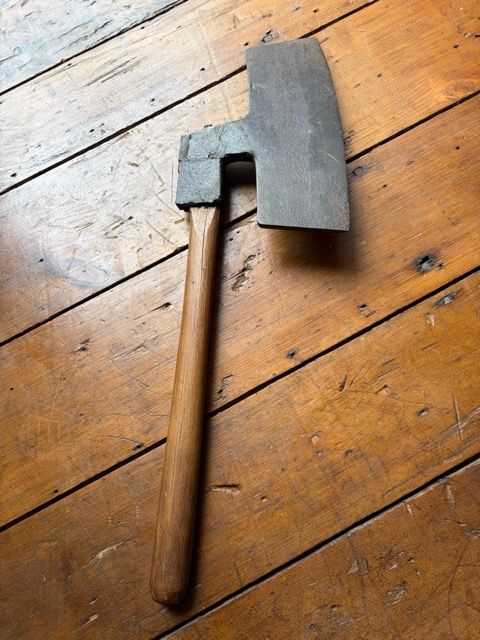
Late 18th to Early 19th-Century Antique Hand-Forged Cooper’s Broad Hewing Axe – Early American / European Barrel Maker's Tool
$265.00
In stock: 1 available
Product Details
This fine late 18th to early 19th-century antique cooper’s broad axe is a specialized hand-forged edge tool crafted for the intricate trade of barrel and cask making. Featuring a single-bevel bit and an offset eye geometry, this hewing axe allowed a master cooper to trim, shape, and angle stave edges with extreme accuracy without scraping their knuckles against the wood.
-
Forged Head: Hand-hammered high-carbon steel/wrought iron construction showing distinct blacksmith fold marks, poll hammering texture, and an authentic dark charcoal age patina.
-
Bevel & Eye Configuration: Features a single-bevel cutting edge paired with an offset eye designed to accommodate a side-canted wooden haft, giving the woodworker clean clearance while shaving straight lines along curved staves.
-
Condition: Excellent antique condition given its 200+ year age. The metal remains sound with light surface oxidation, subtle forging flaws, and honest hand-tool character. Free from major structural cracks or weld separation.
History
During the late 1700s and early 1800s, coopering was one of the most vital industrial trades in both Europe and colonial America. Coopers produced tight barrels for shipping liquids (whisky, wine, rum, salted meat) and slack barrels for dry goods (flour, gunpowder, grain).
Because barrels relied entirely on precise wood-to-wood joinery held together by iron or wooden hoops, every stave had to be hand-hewn at exact angles. The cooper’s broad axe was a highly specialized variation of the traditional timber-framing broad axe: shorter, lighter, and angled specifically for fine, controlled bench work. Authentic 18th-century cooper's axes are prized artifacts of early trades, blacksmithing, and maritime industrial history.
Dimensions
-
Head Length (Poll to Cutting Edge): ~7.0 – 9.0 inches
-
Cutting Edge Width (Bit): ~6.0 – 8.5 inches
-
Poll Width: ~1.0 – 1.25 inches
-
Head Weight: ~2.5 – 4.0 lbs
-
Total Weight (with Haft, if handled): ~3.5 – 5.0 lbs
Late 18th to Early 19th-Century Antique Hand-Forged Cooper’s Broad Hewing Axe – Early American / European Barrel Maker's Tool